
Veterans On a Mission
Story and Photos by Stephanie Meyer

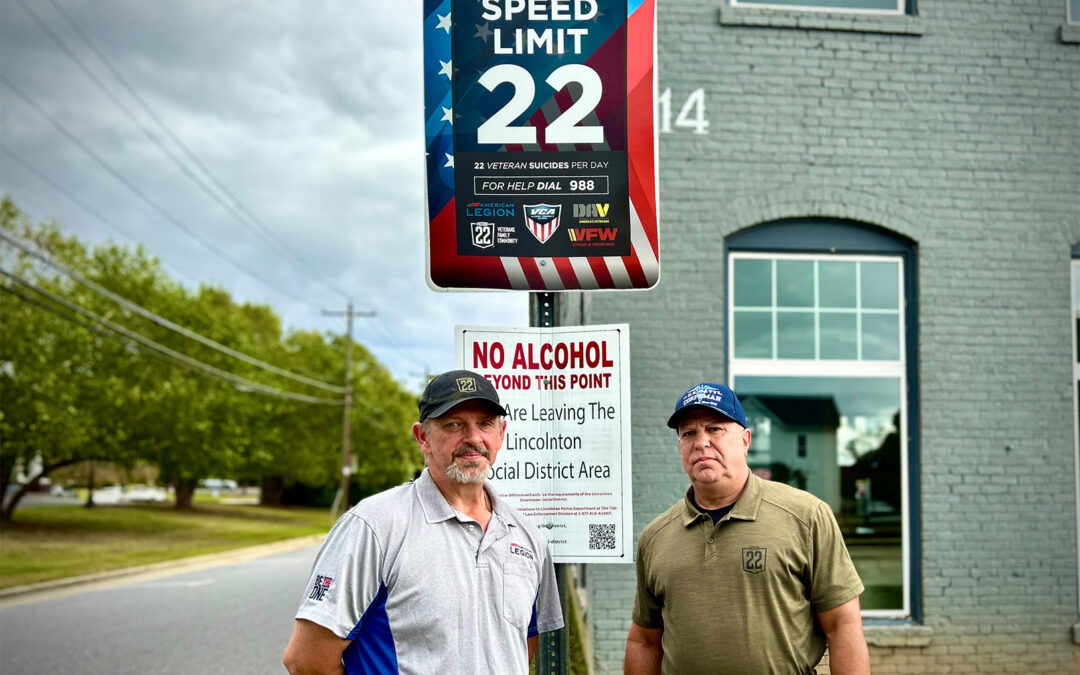
The Veterans Administration estimated 22 veterans a day die by suicide. The speed limit signs are designed to help spread awareness and connect veterans to vital resources.
On the streets of downtown Lincolnton, where daily life moves at a familiar pace, some unique speed limit signs have dotted the landscape. These markers stand as more than simple speed limit indicators—they’re also stark reminders that for many veterans, the most dangerous battle begins after the uniform comes off. The signs are for Mission 22, a nonprofit organization dedicated to raising awareness of veteran suicide and connecting veterans and their families with life-saving resources. Behind the effort locally are two veterans who know all too well that the struggles are real, relentless, and often invisible. Chris Duschel, U.S. Marine veteran and District 22 commander for the American Legion, and Kevin Evans, a former Air Force veteran and North Carolina ambassador for Mission 22, share a common mission shaped by personal loss. “Nobody even noticed anything. He seemed fine,” Duschel says, remembering a fellow veteran and close friend who tragically took his own life. “I talked to him every now and then; he seemed totally fine.” Stories like this are not uncommon within the veteran community, and exactly why Duschel and Evans are committed to making sure help is visible, accessible and talked about openly. Mission 22 takes its name from a sobering statistic: in 2013, the Veterans Administration released a report estimating that 22 veterans die by suicide every day. That number has since lowered, but not by much. The latest available data from the VA puts the figure at about 18. For Evans and Duschel, they say they won’t be satisfied until that figure is zero. “Even if it’s only one, it’s still too many,” says Evans.
Where it All Began
Founded in 2013 by two former Green Berets—Magnus Johnson and Mike Kissel—Mission 22 was established to address the lack of support many veterans experience when transitioning to civilian life. As for the speed limit signs, they are part of a growing movement with multiple cities participating. Similar Mission 22-inspired speed limit signs can also be seen in Port Royal, S.C., for example. While Duschel is not formally affiliated with Mission 22, the organization’s mission inspired him to develop the speed limit sign project now seen in downtown Lincolnton. “It seemed like something that was really important, and a lot of people don’t know about it,” Duschel says. “The signs help bring awareness to this very dire issue.” Working with the City of Lincolnton, Duschel developed a design and arranged for the signs to be placed throughout downtown. The City took his initial vision and turned it into a simple yet striking finished product. “I came up with a basic design, but the people working for the City did the rest. The first time I saw it, I teared up. I thought it was amazing,” he says. Each sign includes clear information about Mission 22 and a crisis phone number for those in immediate need. “That’s the beauty of the signs,” Evans says. “When you pull up to one it tells you everything you need to know.”
Seeing the Signs
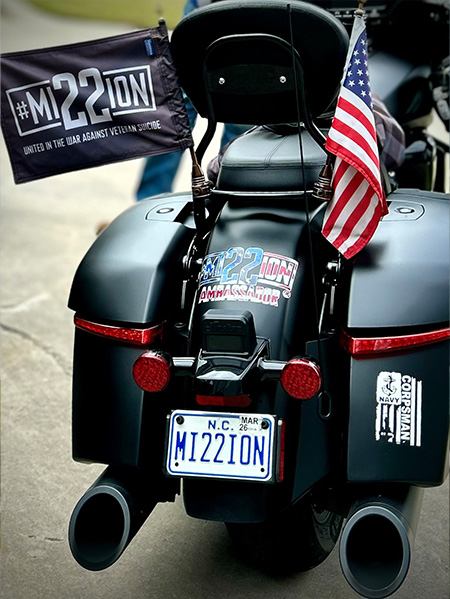 Evans has seen how the signs are doing exactly what they were intended to do—start conversations. Recently, at a Combat Veterans Motorcycle Association event in Waynesville, attendees approached him already familiar with the Lincolnton signs. “We’re hoping it catches like wildfire,” Evans says. As Mission 22’s North Carolina ambassador, Evans works to connect veterans and their families with resources and partner organizations. Though he did not deploy, Evans served during Desert Storm and feels a strong responsibility to those who experienced combat. “That’s why I work so hard for Mission 22,” he says. “I want to give back to the brothers and sisters who have been through that.” Duschel, who oversees 12 American Legion posts as district commander, also uses his role to amplify the mission. “Our post is a huge supporter of Mission 22,” he says.
More Than Awareness
While the signs are great for getting the message across, both men stress that Mission 22 is about far more than raising awareness—it’s about providing practical, life-changing support. “Our slogan is, ‘We are united in the war against veteran suicide,’” Evans says. “We are veterans, family and community, and our goal is to get resources to veterans who are suffering from post-traumatic stress disorder, traumatic brain injury, substance abuse, military sexual trauma…whatever they may be suffering from, we want to improve their quality of life and ultimately end veteran suicide.” A key part of that mission is recognizing that veteran trauma affects entire families. “I love Mission 22 because we also have programs for the family,” Evans says. “We understand that the veteran’s struggling, and if they’re fortunate enough to have a family, guess who else is struggling? And I would argue maybe even more, because they’re watching their loved one feeling helpless, hopeless. Where can they turn? Well, Mission 22 has help for them.”
How It Works
For veterans and family members seeking help, Evans says the first point of contact is often Mission22.org. The website is designed to be easy to navigate and accessible even to non-veterans seeking community resources. Mission 22 itself is not a crisis organization, but it offers a wide range of wellness and recovery programs designed to promote long-term healing and resilience.< Its Recovery and Resilience (R+R) program—recognized as a leader in holistic care and reintegration—blends coaching, nutrition, fitness, mindfulness and biometric tracking. The program lasts one year for combat veterans, six months for non-combat veterans and six months for family members. “We’ve won an award for holistic healing for our Recovery and Resilience program,” Evans says. “And we’ve actually just spun off of that.” That spinoff, called R+R Coaching, was four years in the making. This 30- to 90-day program offers intensive PTSD counseling for veterans who may not be ready to commit to a yearlong program. “It takes the veteran out of their comfort zone more,” Evans says, “but they’re getting a lot of good feedback from it.”
The Invisible Triggers
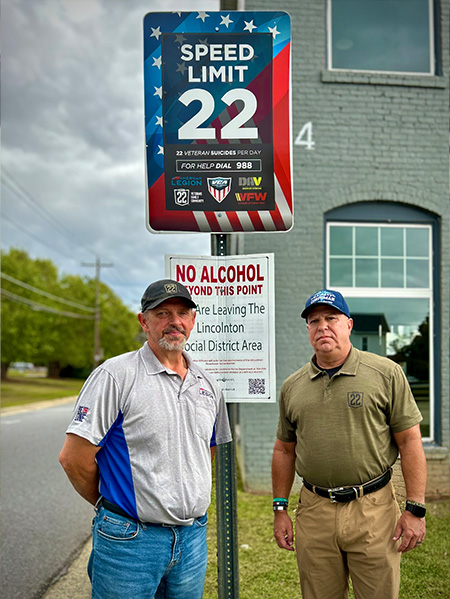
Chris Duschel (left) and Kevin Evans (right) stand by one of the Mission 22-inspired speed limit signs on Water Street in downtown Lincolnton.
When asked about the leading cause behind veteran suicide, Duschel offers a straightforward answer without hesitation: “Stress,” he says. “And not having anybody to talk to about it.” If that stress is compounded with complex issues like PTSD or MST, everyday situations can quickly become overwhelming. “You know, it’s OK for us to walk through the local Wal-Mart,” says Evans. “But for some, that’s all it would take. Crowds, loud noises, a scream, a crying baby…just normal everyday activities can trigger a crisis.” Because Mission 22 is not a crisis intervention program, it relies on partner programs to help the most at-risk veterans in immediate need. Vets4Warriors is one such partner, and underscores the importance of peer connection. “When they contact them, they’re talking to an actual veteran,” Evans says. “That helps eliminate what we call the ‘white coat syndrome.’ Most will talk to another veteran before they’ll talk to anybody else.”
Starting the Conversation
“Just keep conversations going,” Evans says. “We do buddy checks. It only takes a second to just say, ‘How are you? Everything good?’ Those two seconds may save a life.” “It’s important to just let them know that you’re there and that you care,” Duschel adds. Mission 22 also emphasizes flexibility in finding solutions. “With Mission 22, it’s not our programs or nothing,” Evans says. “When we say we want to stop veteran suicide, we mean it. If you don’t like our programs, keep talking to us and we’ll see what we can find for you. We know we don’t have all the answers or all the solutions. And every case is different; there is no textbook case.” As the signs continue to stand along Lincolnton streets, their message remains powerful. They reflect one of Mission 22’s guiding beliefs: “When their tour is over, our mission begins.” For Duschel and Evans, that mission is personal—and far from finished.
Learn More
To learn more about Mission 22, visit Mission22.org or Vets4Warriors.com.
If you or someone you know is in immediate crisis, dial:
855-838-8255 for Vets4Warriors Veteran Peer Hotline
988 for the Suicide and Crisis Lifeline
Concert Benefitting Mission 22 – March 1, 2026 @ 7 p.m.
Untapped Territory will host a benefit concert on March 1st featuring an impressive lineup of local musicians including Bailey Marie, Shane Willis, Daniel Jeffers, and Zee Phoenix. The show starts at 7 p.m. and donations will be collected at the door.