
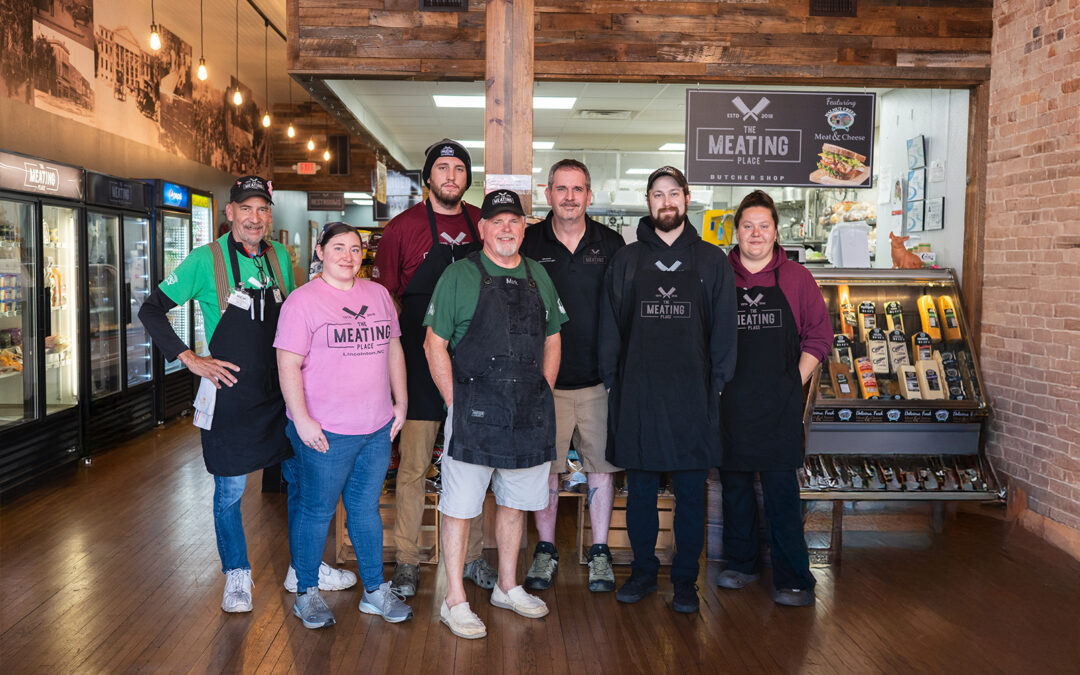
The Meating Place
Your Friendly Neighborhood Butcher Shop
Story by Stephanie Meyer
Photos by Robert Webb
 Late morning in downtown Lincolnton unfolds at an easy pace, when the lunch crowd has yet to arrive and the streets move calmly, hinting at the busier hours ahead. At The Meating Place, the soft chime of an old-fashioned doorbell rings every few minutes as customers step in from Main Street. Behind glass cases, butchers prep cuts of beef and pork and answer questions with the ease of people who know their regulars by name. Bright red steaks, fresh seafood, towering rolls of deli meat and neatly stacked blocks of cheese fill the coolers. Sunlight pours through the front windows, glinting off stainless steel and hardwood, while empty tables along the window fill almost as quickly as they’re cleared.
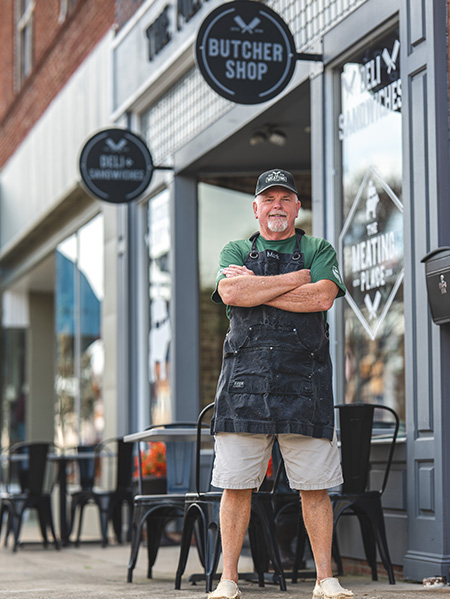
Toward the back of the shop, owner Mark Ingle stands in conversation with another man. It feels less like business and more like a chat between neighbors, a reminder that here, the lines between work and community often dissolve. Ingle, a friendly Southern gentleman, offers me a handshake and suggests sitting at one of the tables overlooking Main Street. As the interview begins, the rhythm of the shop continues uninterrupted: the gentle ding of the doorbell, the ambient hum of conversation, the steady work of a neighborhood business in its element.
The atmosphere feels like a step back in time, to a bygone era when the local butcher shop was more than a place to buy meat. It was where people swapped stories, shared local news and built relationships alongside their grocery lists. That sense of connection is the heart of The Meating Place, which opened in 2018 and has since become a downtown fixture.
“This is what I had in mind,” Ingle says. “That hometown feel.”
Ingle and his wife, Cindy, both Lincolnton natives, own The Meating Place. Mark also owns Ingle Builders, with an office next door. Nearly a decade ago, he was serving on the Downtown Development Association, a time he remembers as challenging for the city’s core.
“We were really hurting in town for businesses,” he says. “We had a lot of vacant spaces. We were always trying to get businesses to come, and one thing I thought we needed was a butcher shop and a general store.”
Despite the perceived need, Ingle couldn’t convince anyone else to take the leap. So he decided to do it himself.
“Never could get anybody to open either one, so I decided to try the butcher shop,” he says. “I didn’t know anything about it.”
What Ingle lacked in experience, he made up for with determination. He watched videos, read extensively, attended a North Carolina meat conference and visited butcher shops, asking questions and offering to help where he could. He even spent a day at a slaughterhouse to better understand the process.
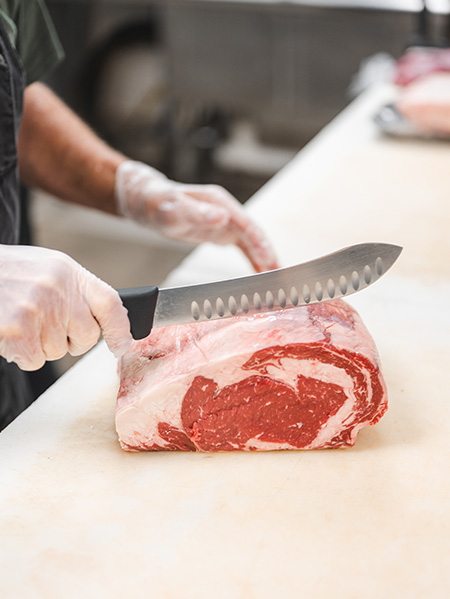
That hands-on curiosity paid off when he met Jeremy Seagle.
“I went to a slaughterhouse and helped them one day, and one of the employees there…he told me that he would be glad to help me out and get this place started,” Ingle says. “We were open Wednesday through Saturday at that time. He came in in the evenings and on Fridays and Saturdays and helped us, and now he’s my manager.”
Seagle had worked for years at Caldwell’s Meat Processing in Maiden, bringing invaluable experience to the new shop.
“It was a lot more [work] than I thought it would be, but Jeremy was a godsend,” Ingle says.
Expanding the Offerings
Another influence came from an unexpected place—Ohio. Ingle’s brother once lived in Amish country and suggested carrying some of their products. That recommendation led Ingle to Walnut Creek Foods, an Amish company that now supplies The Meating Place with deli meats, cheeses, sweets, salads, eggs and more.
“When we first opened, we were buying about $1,000 worth of products from them every other week,” Ingle says. “Now we’re buying close to $3,000 a week.”
About a year after opening, customers offered another suggestion: sandwiches. Ingle listened.
“People kept after me to do sandwiches in town, so we started the sandwich business and that’s gone very well,” he says.
The sandwich operation brought another key team member into the fold. Rico, who had spent his career working in delis, offered his expertise.
“Another godsend was Rico,” Ingle says. “He worked in deli all his life. He knew all about the deli and the sandwiches so he’s been a big help.”
A Menu Built on Quality
The sandwiches quickly became a cornerstone of the business, made with the same meats sold in the cases. There’s no grill, which means no burgers or hot cooking—except for one notable exception: meatballs.
“I was going to buy meatballs and Rico said, ‘No, you can’t buy them—we’ll make them,’” Ingle says. “So he came up with a great recipe and people love our meatballs.”
Customers love them so much, in fact, that The Meating Place sells about 1,000 meatballs a week. They’re available in the popular meatball sub, or in eight-packs that customers can take home and prepare however they like.
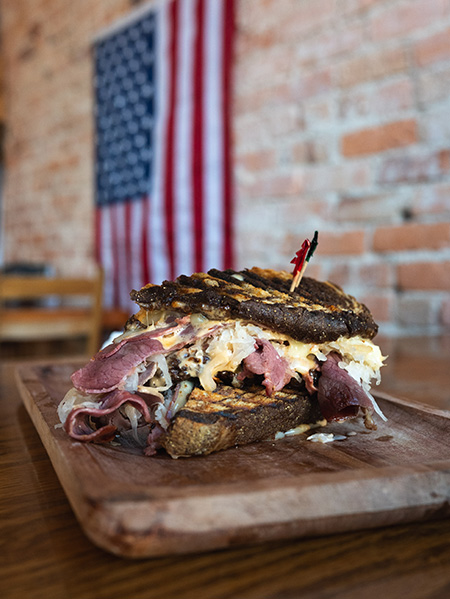
Still, meatballs aren’t the most popular item on the menu.
“The Reuben actually is the most popular,” Ingle says. “The Reuben, turkey, and meatball sandwiches are the top three.”
With a smile he adds, “People tell us we have the best Reuben outside of New York.”
Holidays are particularly busy, and Ingle encourages customers to order early. Smoked Amish turkeys, rib roasts, steaks and quarter hams are especially popular. Christmas is their busiest week of the year, followed closely by Valentine’s Day.
The shop sources hogs locally and processes them in-house, turning much of the pork into sausage and bone-in chops.
“We make about seven different kinds of sausage here in-house,” he says.
The shop’s mountain vibe and general store atmosphere were inspired in part by specialty shops found in the Western part of the state. During his research phase, Ingle says he visited a store in Saluda, NC as well as some mountain grocery stores. Nearly everyone he consulted was encouraging, except one.
“I talked to someone at a grocery store and I said, ‘You got any advice for me?’ He said, ‘Yeah, don’t do it,’” Ingle recalls with a laugh. “I didn’t listen to him though.”
Lincolnton is better for it. Not only does The Meating Place provide high quality meat and food products to the residents of Lincolnton, it also partners with other local businesses, including Local Roots, which sources steaks and ground beef from the shop. Additionally, customer feedback continues to shape offerings, including sweet Lebanon bologna—an Amish deli meat suggested years ago by the mayor’s wife.
“It’s really good,” Ingle says. “It’s been a big hit.”
Why a Neighborhood Butcher Still Matters
Shopping at a neighborhood butcher shop, Ingle explains, comes with advantages.
“It’s better quality, to start with,” he says. “And it’s healthier because we don’t put dyes or preservatives in it. So it’s not going to last as long as what you buy in Walmart, it’s going to turn brown quicker, but it’s healthier and better for you.”
That quality keeps customers coming back. Many shop weekly for their meat, while some downtown workers stop in daily for lunch.
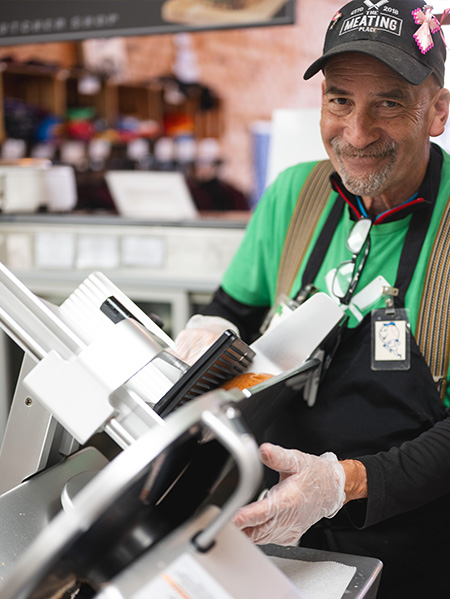 Service behind the counter is personal and tailored. If a customer has questions about the best way to prepare a cut of meat, or has a special request, Ingle’s dedicated team members make every effort to oblige.
“We can tell you how to cook it, cut it how you want it,” Ingle says.
That commitment to customer service is a key ingredient in The Meating Place’s success. The other is their high standards for product quality, reflected in their Certified Angus Beef selection.
The United States Department of Agriculture rates beef products in three primary quality grades: select, choice and prime. Certified Angus Beef is a brand that only sells beef that falls into the upper tier of choice or prime grades.
As Ingle puts it, “If it says ‘Certified Angus Beef’, you know it’ll be good.”
Then, now, and looking ahead.
While it’s clear that Ingle is open to growth and change, he also has a sense of pride when looking at the store’s past. Though the structure itself wasn’t always pretty, the building carries a lot of Lincolnton history. Ingle purchased and fully renovated it, transforming what he says used to be “the ugliest building in town.”
A mural inside features old photographs of downtown, connecting the present-day shop to the town’s past. As Ingle looks to the future, he says he plans to spend more time at the shop after his retirement.
“My favorite part about it is the people—the customers,” he says. “I enjoy meeting people and serving people and providing a good product and service.”
With our interview wrapped up and the lunch rush growing busier by the minute, I planned to gather my notes and make my exit. But before leaving, Rico insisted I sample of his famous meatballs. Any attempt at journalistic detachment disappeared after the first bite. Warm and savory, with a subtle sweetness balanced against the bright acidity of the tomato sauce, they delivered a kind of simple, wholesome comfort, much like the shop itself.
On a late sunny morning in downtown Lincolnton, with the doorbell chiming and the hungry lunch crowd forming, it’s clear The Meating Place has become what Mark Ingle hoped it would be—a neighborhood shop where good food, familiar faces and small-town rhythms “meat” under one roof.