
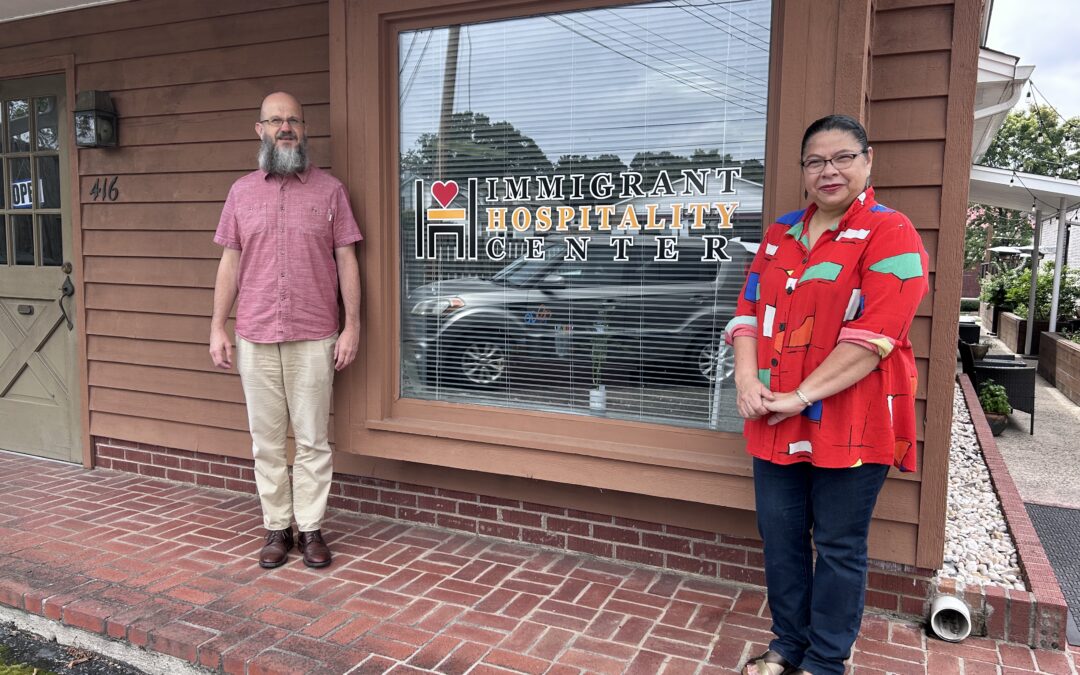
Welcome Home
How the Immigrant Hospitality Center Serves the Lincolnton Community
Story and Photography by G.S. Underhill
A lot can happen when you sit down at a table and listen to someone’s story. It was at such a table in a Lincolnton coffee shop in 2017 that early conversations about starting an immigration ministry first took shape.
Bobby Farmer, Ministry Consultant for Hulls Grove Baptist Church in Vale and Director of the Immigrant Hospitality Center in Lincolnton, says his journey toward that moment was shaped by a long-standing commitment to cross-cultural ministry. He is quick to emphasize, however, that the Center’s founding was never a solo endeavor. Support came from state-level religious leaders, local churches, business owners, and volunteers—what Farmer describes as “a divine network of relationships.”
“Being the Ministry Consultant at Hulls Grove, I oversee all of our missions outreach, which of course is cross-cultural,” says Farmer. “It predominantly began with Mexico and Costa Rica, with a smattering of other countries here and there. But in doing that, I also became acquainted with the first Hispanic church planter here in Lincoln County who came in the late 1970s.”
Those relationships expanded over time through collaboration with pastors and leaders in the North Carolina Baptist State Convention, where Farmer became known for his willingness to engage across cultural lines.
“People knew that I had a heart for people from other cultures,” says Farmer. “Back in 2014, there was an interest in the State Convention to start some kind of immigrant outreach, but they didn’t really know how to go about it.”
Even then, immigration required careful navigation within a denomination focused on evangelism rather than political advocacy.
“Southern Baptists can be touchy about that, like are we promoting the gospel, or the social gospel?” says Farmer. “They wanted to navigate a way to minister to the Hispanic Latino community in a way that didn’t cross the appropriate boundary, but yet also interacted with them in an area of need. And the biggest area of need is now and was then, immigration law.”
Building the Foundation
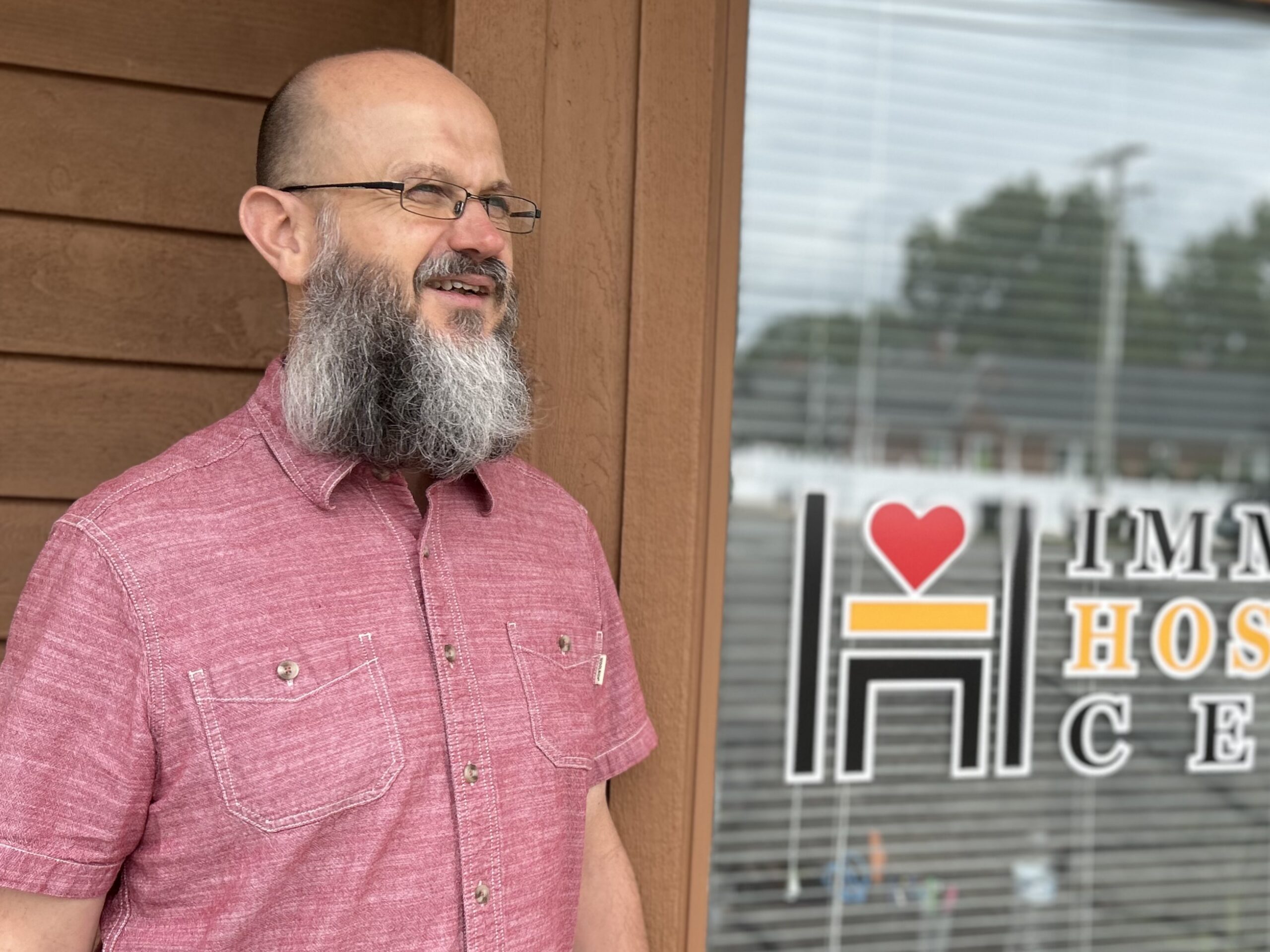
Bobby Farmer serves as Director of the Immigrant Hospitality Center. The Center’s logo, a heart above a table with two chairs, represents the Center’s dedication to serving immigrants through conversation and love for the stranger.
By 2017, plans for an immigration ministry in Lincoln County began to move forward. Farmer undertook extensive training, completing a weeklong certified course in immigration law, followed by 40 hours of supervised fieldwork under a U.S. Department of Justice–accredited immigration law professional.
With guidance from the Council on Immigrant Relations, a nonprofit based in Raleigh, the Immigrant Hospitality Center officially opened on January 27, 2019. Community support was immediate and tangible, with donations covering nearly every aspect of the Center’s physical space.
“John Gilleland and his partner did all of this,” says Farmer. “All the furniture was donated by other organizations. Everything in this building didn’t cost a cent. It all came together just like that.”
Not everyone, however, has been as supportive.
“I had a man cuss me out at the coffee shop,” says Farmer.
Some skepticism has also come from within his own faith community.
“There are some pastors in this association of Baptist churches that disagree with what I’m doing,” says Farmer. “But everything we do or advise is within the limit of immigration law.”
Farmer says opposition often stems from religious bias, cultural misunderstandings, or nationalist thinking. Still, he believes personal conversations can help shift perspectives.
Stories That Show Humanity
“There’s one story I use all the time because it shows the real humanity of the immigrant,” Farmer says. “You don’t get that on the news, you just get the spin.”
He recounts the case of a distraught mother who contacted the Center asking for help with her teenage daughter.
“Her dad was trying to sell her into prostitution at 14 years old,” Farmer explains. “She ran away, made it through Mexico, crossed into the United States, and was deported because she came unlawfully.”
After being deported, the girl fled again, was kidnapped by a drug cartel in Mexico, escaped, and eventually reached the U.S. border a second time.
“She finally got in front of an immigration judge,” Farmer continues. “They researched her story, issued her a court date and sent her on a bus to North Carolina to reunite with her mom.”
While the mother was granted sole custody, concerns about her daughter’s legal status led them to the Immigrant Hospitality Center.
“Bless her heart, she could hardly look at you,” Farmer recalls. “She had been through so much.”
The Center helped her apply for Special Immigrant Juvenile Status, a protection for children who have been abandoned or abused. Her application was approved, placing her on a path to lawful permanent residency.
What the Center Does
The Immigrant Hospitality Center’s mission is simple: to provide high-quality, compassionate immigration legal services and foster community awareness. The process begins with a one-on-one screening session, in person or online, where clients share their stories and receive an initial assessment to determine if a lawful pathway exists. That’s where the process often gets more complicated.
“Second to the tax code, immigration law is the most complicated law in the land,” says Farmer. “There’s not an easy or cheap way to become a resident or citizen of the United States. But our job is to help people understand what’s necessary to be here lawfully and to walk them through that process.”
When no legal pathway exists, the Center advises clients accordingly.
“If they are out of status, meaning their status expired, or they don’t have that lawful status, we tell them their best avenue is to return to their home country,” Farmer explains. “Of course once they walk out of the office, it’s up to them. But we advise them to the extent we can advise them, by the law by the Department of Justice.”
If clients require criminal or civil legal expertise, the Center refers those cases to professionals in those areas. Similarly, those needing mental health services or medical care are connected with licensed providers. The Center also leads community education efforts on immigration-related fraud, scams, and abuse.
An Immigrant Voice
Miriam Acevedo, who works alongside Farmer and is partially accredited in immigration law, knows the challenges of immigration firsthand. An immigrant herself, she came from Ecuador in 1987 through a program called consular processing, which allows a foreign national to apply for an immigrant visa at a U.S. Embassy abroad. Years later, she and her husband founded Calvary Hispanic Baptist Church in Cherryville, where they continue to serve as pastors.
Acevedo’s perspective blends compassion with critique.
“In the days when I was younger, the only way you could immigrate to the United States was the legal way,” Acevedo recalls.
Over the years, she has witnessed the system change dramatically, both in policy and perception.

Miriam Acevedo leads client services and operations at the Immigrant Hospitality Center.
“This administration is really hard on immigration,” says Acevedo. “But in the Biden administration there was mass migration, with all of these families in caravans who came and were welcomed. Then [the Trump administration] started turning them away.”
Acevedo is referring to the sweeping executive orders issued by President Trump in January 2025, many of which focused on immigration reform.
While executive orders can affect policy, they are not yet recognized as law, allowing the Supreme Court to block them through judicial review. However, that process takes time, and things can get confusing and chaotic in the interim. Still, Acevedo says changes were necessary to address the issues within our immigration system—a system she believes had become overloaded and misused.
“Of course we need to welcome the immigrants,” Acevedo says. “But Biden did it the wrong way. I have clients who did receive social security, medical insurance,” says Acevedo. “It’s not just fake news.”
In North Carolina, non-U.S. citizens can get full health coverage through NC Medicaid, if they live in North Carolina, meet age and income requirements, and have a qualified immigration status. However, some people must wait five years from when they get their qualified immigration status before they can apply for full NC Medicaid.
Non-U.S. citizens are legally entitled to Emergency Medicaid, which is not standard health coverage and is not something individuals apply for. Emergency Medicaid is a limited program used by hospitals to cover the cost of emergency care they are legally required to provide under federal law, regardless of the patient’s immigration status.
Because Medicaid is regulated at the state level, eligibility for non-U.S. citizens can vary from state to state.
“By law they can’t receive federal benefits,” Farmer explains. “But when states choose to grant certain benefits it’s hard to pinpoint how much of that may be from federal money given to the state. And of course state benefits are granted depending on whether the state has restrictive policies or welcoming policies, which of course are tied to politics.”
Acevedo stresses that immigration cannot be separated from politics.
“It’s a political issue,” says Acevedo. “You can’t be neutral.”
While broader debates about detention conditions and enforcement tactics continue, the Immigrant Hospitality Center remains focused on practical assistance for local immigrants rather than political advocacy.
“[Immigrants] want something better for themselves, and they want to contribute to the community,” says Acevedo. “But you have to have something, some documentation, to show that you are who you say you are.”
She also calls for accountability for employers who exploit undocumented labor.
“As a foreigner, I see how hard immigrants work,” she says. “Farmers, construction, cabling, these are tough jobs. Not everyone wants to do that kind of work, but they do. The government should penalize companies that take advantage of undocumented workers, or at least help those companies find ways to employ them legally and pay them fairly.”
At the local level, she urges empathy alongside respect for boundaries.
“If you have a neighbor who is Hispanic, or African, or whatever, be a blessing to that person,” she says. “Diversity isn’t wrong. Don’t look down on a person because they come from a different country; but every country has borders, and we should respect them. Borders are protection, just like fences around your home.”
Full Circle
For Farmer, the Center’s work always returns to relationships and the simple act of listening.
“This was all through the favor of God and through relationships,” he says. “And it all started with a discussion around a table at Fausto Coffee.”
At that table, what began as a conversation and an idea has grown into a full ministry that continues to change lives, one story at a time.
Sources: U.S. Census Bureau 2024 American Community Survey 1-Year Estimates; North Carolina Office of State Budget and Management; North Carolina Department of Health and Human Services, NC Medicaid Division of Health Benefits; Pew Research Center.
G.S. Underhill is a writer living in Lincolnton N.C.